Signed in as:
filler@godaddy.com

- Link to Substack -
Few songs confront the bitterness of love and loss as starkly as Richard “Rabbit” Brown’s “James Alley Blues.” Harry Smith, the architect of the Anthology of American Folk Music, called him “the first and most important New Orleans folk singer to record.” Decades later, legendary music historian Greil Marcus declared James Alley Blues “the greatest record ever made.” Brown cut six sides in 1927 with Victor’s famed talent scout, Ralph Peer, and then he nearly vanished. No photograph. No obituary. Almost no trace in the public record.
And yet James Alley Blues has lived on.
Bob Dylan was singing it before he recorded for Columbia. Years later, he even incorporated one of Brown’s lines into one of his own songs, Crash on the Levee (Down in the Flood): “It’s sugar for sugar and salt for salt / If you go down in the flood, it’s gonna be your fault.” The song’s disappointments, its endurance, its wry humor, cut as close to the bone as a song gets.
For nearly a century, Brown has been treated as a ghost. But new research, that I have unearthed in police blotters, city directories, and family records, brings him into focus, not as a phantom but as a man: a writer of topical songs and a chronicler of his world. That was the mystery that drew me in, not in New Orleans, but a thousand miles upriver, in Minneapolis.
When I was getting my start as a young folk musician in Dinkytownin the late 1990s, it was impossible not to feel the weight of Bob Dylan’s influence. I knew his old haunts, the 4th Street sidewalks, the pitted iron trestles, the Bunge grain elevator, and the train yards that skirted the University of Minnesota.
I knew the Sammy fraternity house and the other apartments he’d called home. I bought a banjo and a guitar from the Podium music store, and I even knew the footprint of the long-gone stage of the 10 O’Clock Scholar. Neighborhoods like Dinkytown, the West Bank, and the now-paved Bohemian Flats crisscrossed the Mississippi and still hummed with the freewheeling spirit of his early years.
By the mid-2000’s, I was lucky to cross paths with Spider John Koerner, and Tony Glover, as well as other local musicians who knew Dylan back then. After chatting with Tony during set breaks for a few months, he offered to play me a few rare Dylan recordings that he had made in the early 1960’s. On one of them, Dylan played a rough, haunted take of James Alley Blues by Richard “Rabbit” Brown.
I recognised it imediately. My brother and I had worn that song into memory years earlier, thanks to the reissue of the Anthology of American Folk Music.
When I was getting ready to record my first album with my folk duo,The Floorbirds, James Alley Blues was one of the songs I felt especially drawn to work up. I didn’t play it exactly like Dylan, and I didn’t copy Rabbit Brown note-for-note either. I tried to make it my own. But even then, I couldn’t shake the voice in that original recording. It was raw, elliptical, and unforgettable.
In 2005, there were few leads. The best source I found was Kevin Fontenot’s excellent article, TIMES AIN’T LIKE THEY USED TO BE: RABBIT BROWN, NEW ORLEANS SONGSTER, originally published in The Jazz Archivist, It sketched a vivid but elusive portrait of Brown as a mysterious New Orleans songster whose music straddled folk tradition and topical performance and whose trail went cold almost as soon as it appeared.

That essay set me in motion. From that point on, I was on the search, trying to piece together a story of a musician who had nearly vanished.
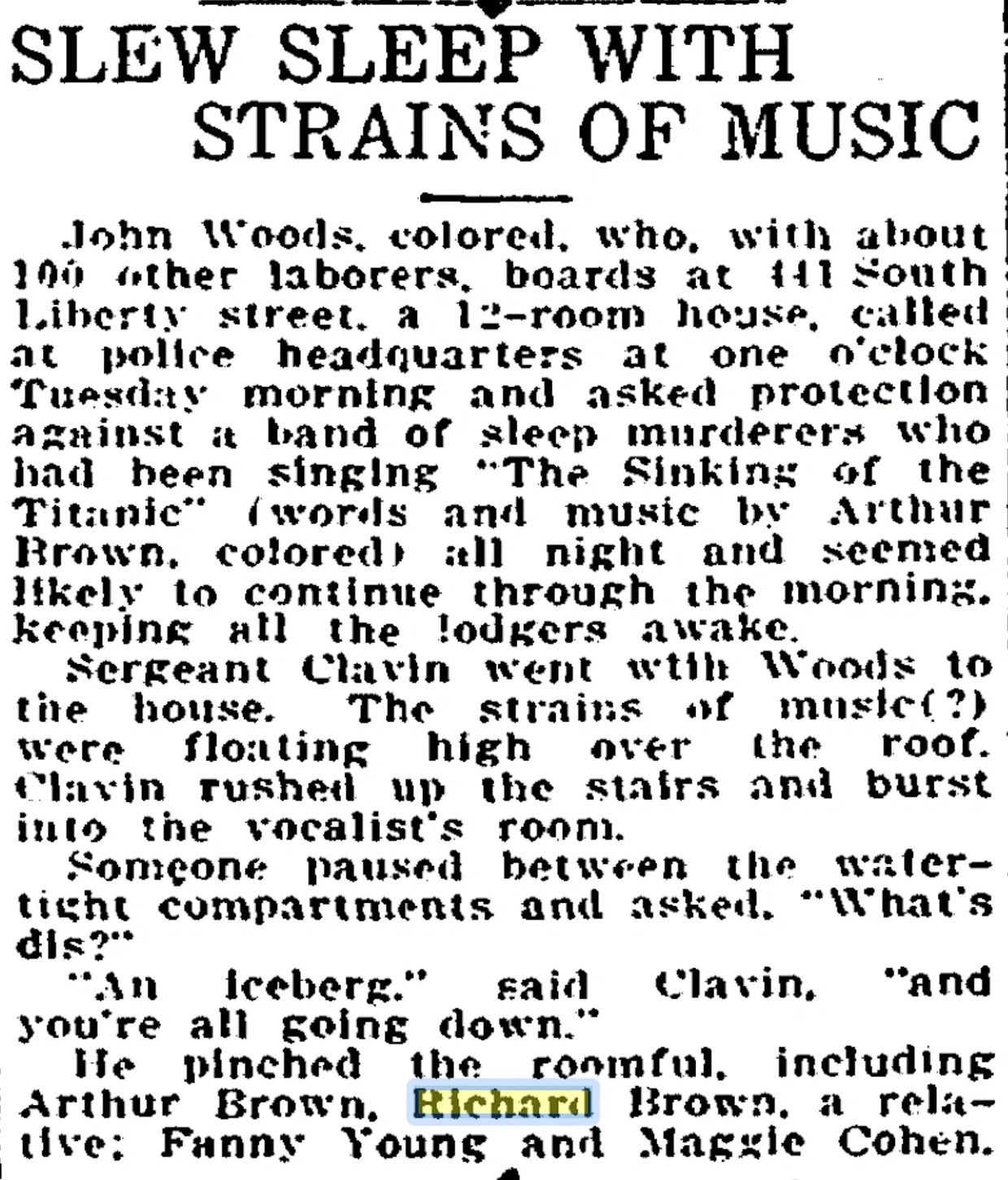
The turning point in this story came in March of 2025, just before a trip to New Orleans with my family. I was searching through a digital archive for another project, researching ballads written shortly after tragic events. I had been combing through century-old newspapers for songs about the Titanic and other disasters; most were dead ends, dance-hall listings, society weddings, and streetcar ads. And then, buried in the July 23, 1912, edition of the New Orleans Item, I found one.
At first, it seemed like just another local police report: two brothers arrested for disturbing the peace. But the names immediately caught my attention, Arthur and Richard Brown, performing a song they wrote about the sinking of the Titanic, barely three months after the disaster.
The article even preserved a scrap of dialogue, as if the moment had been waiting all these years to be overheard again: when a police sergeant burst into the room, one of the brothers reportedly asked, “What’s dis?” The sergeant shot back, “It’s the iceberg, and you’re all going down.”
I didn’t know it yet, but that exchange was the missing thread I’d been chasing for years, the one that would lead me straight into the heart of Rabbit Brown’s story.
That detail was strange and theatrical, exactly the kind of scene a performer like Rabbit Brown might create. More importantly, the song they were singing matched one of his known recordings, The Sinking of the Titanic. I pulled the corresponding police report from the New Orleans police blotter, which confirmed the arrest that nightand revealed the addresses for both Richard and Arthur. Richard’s residence was listed at 1956 Poydras Street, in the heart of New Orleans’ 3rd Ward.
From there, the story opened up. I began tracing Richard Brown through city directories, census rolls, marriage records, obituaries, and police ledgers, then aligning fragments from public records with reminiscent testimony from Brown’s contemporaries. A fuller picture emerged, not just of a name on the label of a well-worn 78, but of a working-class Black musician whose voice once carried through the streets of the Battlefield, Jane Alley, and the surrounding neighborhoods.
Richard “Rabbit” Brown was a songster, a serenader, a musical shape shifter moving between vaudeville, blues, minstrel satire, Tin Pan Alley melodies, and the early edges of jazz. He was a fixture in the same alley where Louis Armstrong was born, singing for people in barrooms, parade routes, and on street corners.
His music rose from the streets of New Orleans, but his story begins across Lake Pontchartrain in Covington, Louisiana, a town whose Black families, including the Browns, were shaped by a remarkable struggle for freedom and dignity in the decades after slavery.
Though most census documents record his birth as 1885, his World War I draft card lists it as November 28, 1887. It lists his address at 1944 Poydras Street, notes his trade as a carpenter for Norton Bros. Construction, and describes him as Black, short, and slender, details that match the recollections of musicians who knew him.
His grandfather, Thomas Brown, was born around 1821 in Maryland and appears in the 1870 census as a laborer in Ward 6 of Covington, with $400 in real estate, a rare and hard-earned distinction for a Black man in postbellum Louisiana. He and his wife, Sarah Jordan, raised a large family, including Henry Brown, who married Agnes Bell in 1873. Henry and Agnes went on to raise at least fifteen children: Rebecca, Estel, Victoria, Henry Jr., Arthur, Richard, Randall, Frederick, Vivian, Lillian, Hazel, Edward, James Luther, and Othelma.
By 1900 the Browns moved to New Orleans. They settled in the city’s 3rd Ward, right in the heart of a tough district known as the Battlefield.

The Battlefield earned its name not from a historic military event, but from the nightly violence that drifted out of its barrooms and boarding houses.
Papa Lemon Nash (b. April 22, 1898), who was raised in New Orleans from infancy, came from a musical family and performed on guitar, mandolin, ukulele, and banjo across the city’s neighborhoods, fish fries, and streets. He traveled with medicine shows, played in Chicago and Detroit, and collaborated with countless local musicians. Nash knew and occasionally performed with Brown, and described the Battlefield in a 1959 interview with folklorist Richard B. Allen:
“Oh, man. Them guys was tough out there. All them guys, had 16 shooter Winchesters. That’s why they call it the Battlefield… Whenever they had a humbug out in the Battlefield… you call the laws up and they wouldn’t go in there… Them guys was bad out there… They had a gang of them Peen brothers… Another fella they call him Stringbean, tall slim fella, guy nearly ‘bout touch that ceiling when he stand up.”
Through the heart of the Battlefield ran a narrow street called Jane Alley, later immortalized in Brown’s most famous song, James Alley Blues. Jane Alley was wedged between Perdido, Gravier, White, and Broad Streets; it is sometimes remembered as little more than a dim corridor in a dangerous quarter.
Yet the archival record complicates the legend. In Stomp Off, Let’s Go, Ricky Riccardi revisits Jane Alley through census rolls, city directories, and police reports. The 1900 census lists thirty-six residents living in eight modest wood-frame houses—fourteen white and twenty-two Black—carpenters, washerwomen, laborers, families with children.
“The inhabitants at the Alley were lower and middle class people,” Riccardi notes, drawing on the research of New Orleans historian Tad Jones. “Many were homeowners, and most were employed and productive citizens.” Police blotters from the period do record arrests for fighting and disturbing the peace, but they do not support the image of a perpetual war zone.
By the late 1920s, Jane Alley began appearing more frequently in police reports, its reputation shaped as much by Prohibition enforcement and racialized sensationalism as by the incidents themselves.
Jane Alley had a hard reputation. But the record suggests something more layered: a dense, integrated working-class block, crowded with daily life.
It was here, in the Battlefield, that Rabbit Brown’s voice began to take shape.

Louis Armstrong (b. July 4, 1900) himself remembered his birthplace, Jane Alley vividly. In his autobiography Satchmo: My Life in New Orleans, he paints the scene with an insider’s eye:
“Jane Alley as some people call it—lies in the heart of what is called The Battlefield because the toughest characters in town used to live there, and would shoot and fight so much. In that one block between Gravier and Perdido, more people were crowded than you ever saw in your life. There were church people, gamblers, hustlers, cheap pimps, thieves, prostitutes, and lots of children. There were bars, honky-tonks, and saloons, and lots of women walking the streets for tricks to take to their ‘pads’ as they called their rooms.”
Armstrong’s recollection adds texture the maps and police reports alone cannot provide. Jane Alley emerges not as legend or caricature, but as a crowded block—hard-edged, noisy, and alive.
Another of Brown’s musical contemporaries, Eddie “Rat” Dawson (b. July 24, 1884) a versatile guitarist, banjoist, mandolinist, and string bassist whose career spanned over half a century. He worked with Freddie Keppard, Kid Rena, and Louis Armstrong, and is said to have introduced plucked bass to the New Orleans scene gave folklorist Richard Allen his own memories of the Battlefield:
“Well, it was pretty bad a long time ago… I’ll tell you.”
Dawson recalled one incident in the Girod Street Cemetery.
“There were dancing roughnecks round there. Yes, sir, and fellas was tough. You couldn’t hardly get a policeman to go back there if something happened. Back then, you had beat police, sometimes on horseback. One time, Bradley took a policeman, took his gun and his club and everything. Had him under arrest, you know.”
The trouble began in the shadows of the cemetery, where gamblers gathered at night to shoot dice by candlelight, keeping the flames low so the beat police wouldn’t see them.
“Policeman would slip up on them and they’d break and run—some down to Basin, the New Basin then, before it was filled in. They’d scatter through the lumberyard and the alleys, and you couldn’t find them. Well, they caught Bradley, and a policeman had him by the pants, walking him to a telephone to call the wagon. Bradley sidestepped, cracked him, and down he went. Took his gun and his club and hammered him. Terrible—guys was bad back then in the Battlefield.”
This was the world that shaped Rabbit Brown, not just the geography, but the texture of daily life. The Battlefield forged the topical urgency in his songs, the humor, the eye for tragedy, the instinct to document. From the early 1900s to 1926, the Brown family lived in a tight row of homes on Poydras Street, not far from Jane Alley. One address appears again and again in police records and city directories: 1944 Poydras, a modest house pressed up against the train tracks, flanked by taverns, churches, family homes, as well as scrap and lumberyards.

And it was here, on the 1900 block of Poydras Street, that Richard Brown started his own family. On January 14, 1909, he married Annie Frances in New Orleans. The marriage certificate names his parents as Henry Brown and Agnes Bell, tying him unmistakably to the Brown family that had migrated from Covington to the Battlefield. This link anchors him in the same family network as his brothers Freddie, Randal, and Arthur, men who, like Richard, would become known in the Ward for their musical and social presence.
But the stability of that first marriage appears to have been short-lived. Around 1913, Richard had a son, Richard Jr., with Margaret Hodge. No record survives of a formal divorce from Annie Frances, but by the following decade, his household and his personal life seem to have taken a different turn.
A newspaper article from 1923 captures one of the few moments Richard Brown steps into the public record not as a performer, but as a neighbor. That winter, a blaze tore through 12 homes in the 3rd Ward. A stiff wind pushed flames down Roman and Perdido Streets after a fire broke out in a one-story shed behind 634 Roman, at the Red Glow Charcoal Company. Wooden houses, “easy prey to the flames,” as the New Orleans States put it, ignited in seconds. Embers jumped blocks away. Alarm bells rang. Bucket brigades formed. Police and firemen rushed to wake sleeping families.
Richard Brown saw it first. According to reports, he “discovered the blaze coming from the charcoal shed,” sounded the fire alarm, and began pounding on doors. Within minutes, a stream of scantily clad men, women, and children poured into the cold. Captain David Jackson and officers from the First Precinct ordered blankets for the shivering crowd.
The fire created a chaotic scene. A Ford truck in a nearby yard went up in flames. A hay-fed horse was burned so badly that it had to be put down by a special agent from the Society for the Prevention of Cruelty to Animals.
The article does not mention that Brown was a musician. That night, he was simply a man with quick instincts, who rang the fire bell and likely saved lives. For a figure so often wrapped in myth, this single act of civic clarity brings him startlingly into focus.
Rabbit Brown wasn’t just a voice in the alley; he was a witness, and in moments like this, a protector of the very world he sang about. The Battlefield gave him his material, and his lens.

By the time folklorists began interviewing New Orleans musicians in the 1950s and ’60s, Richard “Rabbit” Brown had already become something of a ghost, but to those who knew him, he wasn’t. He was remembered as a working musician whose voice could cut through the noise of a fish fry or house party and could keep the party dancing.
Lemon Nash, who collaborated with Brown for a short time, recalled Brown to Richard Allen, both with affection and with blunt criticism.
First, a story that captures Brown’s resourcefulness:
“He used to go out at Mama Lou’s, and if things got tough out there and he didn’t make no money, he’d call up the fire wagon, you know. And he knew all the guys on the fire wagon, and he’d give ‘em a false alarm. They’d all get out there and there wouldn’t be no fire, and he’d say, ‘Hey, how about getting a ride back in town with y’all?’ That’s how Rabbit would get back!”
Perhaps the firefighters remembered him, too, from the night years earlier when he called in the alarm that night.
Then, in a more critical light:
“I know Rabbit—I used to play with Rabbit, a couple of times. But Rabbit played so bad that I had to let him go! Rabbit just hit the guitar and hollered. I mean his coat tail—he had a frock tail coat he used to wear—and the coat tail would just be sailin’. He was what you call a clown man.”
Nash, who was younger than Brown may have looked at Rabbit as a performer past his prime, a musician from another era, that by the time Nash was out serenading with Brown’s young Nephew, seemed to be more of a throwback to the minstrel era than the jazz age.
Songsters drew from a vast, genre-crossing repertoire of ballads, spirituals, minstrel songs, work songs, and popular tunes, blending African American traditions with the broader field of American music. Performing on street corners, in medicine shows, juke joints, and fairs, songsters were cultural storytellers and community connectors, shaping the roots of blues, country, jazz, and rock.
Eddie Dawson, was also asked by Richard Allen if he recalled Brown:
“Rabbit? Yeah, Rabbit. He wasn’t much, but he used to sing a whole lot. You know, fake—sing around and go around and play around at fish fries, you see. They had a lot of fish fries, every Saturday night, you see. All around Cypress Street and all them people used to give fish fries, and hang a red lamp out on the front, on the gateway. Red lamp—that’s fish fry. People would go in there and sit down and eat fish and drink beers and talk, you know. And there they had a drink they called gin and razz—gin and razz. You put raspberry syrup in it and it’s pink. Wine… and all that stuff.
And then Rabbit used to go around and play at the fish fries, you know. And they’d pay him—he’d get a dollar and a quarter a night, that’s all. A dollar and a half. He would sing and play.”
(Richard Allen) “Richard Brown? They called him Rabbit?”
“People’d get in there and dance by just to his guitar, and he was singing—singing and playing the guitar. He could sing too, you know. And it’d be packed in there. It was a house party, you know—a fish fry. Just a house like this, sometimes three rooms filled with people. And people used to make money off them fish fries too.”
When Allen mentioned finding one of Brown’s records, Dawson didn’t recall that Brown had made any records at all. He told Allen that Rabbit had been dead for a long time.
Clarence “Little Dad” Vincent (b. 1892, East Baton Rouge Parish) was a self-taught guitarist and banjoist who became a central figure in early New Orleans jazz. Leader of the Liberty Bell Band, he played for both Black and white audiences in venues from Economy Hall to the Roosevelt Hotel, and even toured in Mexico. Vincent knew and performed with many of the greats, Punch Miller, Buddy Petit, Chris Kelly, and remembered Richard “Rabbit” Brown vividly:
“Rabbit, he used to play guitar and sing—(laughs)—and he’d do it by himself. We used to go over off skirting sometime, Rabbit would talk from New Orleans all the way to Baton Rouge without stopping. And he’d come back that night—he couldn’t talk at all. He was hoarse!
He used to play all them funny kind of songs, you know? Some would be—you didn’t know—he would do them make-up kind of songs.”
Horace “One-Leg Horace” White, a legendary second-liner who lost his leg in a streetcar accident but remained a fixture in parades and jazz funerals, claimed to be the most famous second-liner of his time. He had drummed with the Eureka Brass Band, played alongside Manuel Perez, and knew nearly every major New Orleans jazz figure from Bolden to Bechet. He remembered casual street-corner conversations with Brown:
“Sometimes I used to catch Rabbit, and I’d say, ‘Hey Rabbit,’ and he’d say, ‘What?’ Say, ‘You all playin’ tonight?’ He’d say, ‘Yeah, man, we’re playing such-and-such a place.’ Say, ‘Alright. Scarlet’s?’ ‘Yeah!’ ‘Well, I’ll get me a pass if you’re all playing for a picnic.”
The street corners of the 3rd Ward were alive with music, some from itinerants passing through, others from local legends, and others who would become world-renowned artists.
Brown’s own family was part of that soundscape. His brother Arthur, arrested with him in 1912 for performing a Titanic ballad, was credited in the newspaper with writing the song. Another brother, Freddie, would later be crowned King of the Zulus, a role of immense cultural visibility in the Black Mardi Gras tradition.
Richard Brown was there too as one of the city’s most exuberant traditions played out in full view.

In the early decades of the twentieth century, Mardi Gras in New Orleans was public theater, where race, class, satire, and power played out in full view. Two parades, in particular, revealed the city’s racial fault lines.
Rex represented the sanctioned grandeur of white New Orleans, regal, orderly, and segregated. Zulu, formed by working-class Black laborers, answered in its own voice: irreverent, musical, self-made.
Where Rex embodied European airs, Zulu inverted the ritual. Through exaggerated costumes and satire, it often mocked the racial order even as it claimed visibility in a city that tried to deny it.
Zulu’s roots reach back to 1909, when a group of Black laborers calling themselves “The Tramps” attended a vaudeville skit at the Pythian Theater titled There Never Was and Never Will Be a King Like Me. Later that night, in a Perdido Street barroom, they reimagined themselves as “Zulus,” setting in motion a tradition that would become central to Black New Orleans culture. Many of its early members belonged to Benevolent Aid Societies, mutual aid organizations that provided medical care and burial support when white institutions refused Black clients. From these societies, ward clubs, and neighborhood circles, Zulu took shape.
Their earliest costumes were deliberate satire: blackface, grass skirts, Spanish moss wigs, painted lard-can crowns, banana-stalk scepters. In 1915, their first float — built from dry-goods boxes and draped in moss and palmetto, rolled through Mardi Gras. By 1916, the organization formally incorporated, anchoring its pageantry in both mutual aid and cultural pride.
The Geddes and Moss Funeral Home, a respected Black-owned business, became one of Zulu’s early pillars, hosting the first official toast of King Zulu and his Queen, a tradition still kept today.

Out of the shadow of war and plague, 1921 arrived.
1921 stood out from other parade years; it was the first Zulu procession since World War I and the Spanish flu pandemic had forced the celebration to a halt. New Orleans, like much of the nation, was still recovering.
When Zulu announced its return, it promised not only a return to the vibrant event of the pre-war years, but something even better than before.
That year, the Brown family didn’t just watch the Zulu procession; they helped lead it. Freddie Brown was crowned King of Zulu Land, a role of immense visibility in the Black Mardi Gras tradition. At his side were his brother Richard “Rabbit” Brown and Richard’s young son, both named in the newspapers as “Royal Minstrels.”
The New Orleans Item painted the scene:
With a thunder of revolvers and a roar of jazz, King Freddie’s “Royal Schooner” sailed up the New Basin Canal and docked near Howard Avenue, met by a throng of cheering New Orleanians. On the royal float, the “Grand Duke and Crown Prince,” Rabbit with his guitar, his son with a banjo, strummed and sang to the crowd.
Freddie, cloaked in magenta and crowned with gold, stood upon the bow with a cigar two feet long between his lips. Around him: jesters, the queen, mock guards, and a comic storyline incorporated into the parade.
The streets shook with celebration as the procession wound down Rampart, Canal, and Carondelet.
That night, the festivities ended at Tammany Hall with a masked ball. There, in true Zulu fashion, the parade queen, played in drag by Alfred Samuel, was replaced by a “nut-brown maiden,” as the newspaper put it.
Somewhere in the festivities, Rabbit’s guitar still snapped out baselines, and his voice sang through the crowd, not yet on Victor Records, but already a songster in the city’s living memory.

This was community theater at its most layered, a stage for working-class Black musicians to step beyond alley corners and barrooms, to perform not as curiosities but as cultural creators. Photographs from the day show costumed figures atop floats and revelers on the sidelines, and one evocative photo from the John T. Mendes collection depicts a group of Maskers, one of whom holds a guitar.
Notably absent in the 1921 parade was Arthur Brown, Richard’s songwriting brother and fellow performer in the infamous 1912 Titanic ballad arrest. The 1921 parade instead showcased another combination of family talent: father and son, brothers and nephews.
It was likely this fusion of topical song, satire, and spectacle that Rabbit Brown carried into the recording studio six years later.

By the spring of 1927, Richard “Rabbit” Brown was already a fixture of the 3rd Ward, a streetwise songster remembered for singing on street corners, saloons, house parties, and on parade routes. But in March of that year, something happened that would lift him out of the noise of the streets and fix his name in the grooves of history.
Ralph Peer, the legendary talent scout and field recorder for the Victor Talking Machine Company, had arrived in New Orleans. Peer was already on the cusp of changing American music; within months, he would travel to Bristol, Tennessee, and record Jimmie Rodgers and the Carter Family, sparking what many call the birth of country music. Just weeks earlier, he had been in Memphis recording the Memphis Jug Band, whose lively, homemade sound was pressed onto shellac for the first time.
But here, in New Orleans, Peer came searching not only for Jazz but for blues. Peer was responsible for discovering other major blues artists like Tommy Johnson, Frank Stokes, Blind Willie McTell, Bukka White, Sleepy John Estes, Jim Jackson, Gus Cannon, Memphis Minnie, Victoria Spivey, Sara Martin, and Sylvester Weaver, to name a few.
Richard “Rabbit” Brown’s, whose music rose from New Orleans back alleys, proved to be another distinct discovery.
Rabbit’s discovery came during a year of personal transition. For two decades, since at least 1907, Brown had lived on Poydras Street, just doors from his father, Henry Brown. Henry’s steady presence had anchored the block until at least 1926, when his name vanished from the city directory. Whether he died or moved North, his absence marked the end of an era.
The Poydras address had been Rabbit’s home through many years of personal upheaval.
In 1927, with his father gone and the Poydras years behind him, Brown moved to 742 White Street, just off Jane Alley.
It was from that address, and perhaps with both grief and restless energy in his voice, that he walked into Ralph Peer’s temporary New Orleans studio.
The room would not have looked like much, a rented space in a hotel ballroom, garage, or office, cleared just enough to hold Victor’s portable recording setup. On a sturdy wooden table sat the Orthophonic apparatus: a Western Electric microphone feeding sound to a cutting head that etched vibrations directly into a wax master disc. Peer and his engineer would have carefully positioned Brown in relation to the microphone, shifting the chair and angling the guitar until the voice and strings balanced cleanly in the groove.
There were no playback monitors, no overdubs, no second chances; the performance went straight to the master disc. Peer’s job was part technician, part psychologist: getting a raw street performer to relax enough to deliver his music into the microphone.
Brown took his place. Peer, seasoned from his recent session in Memphis and dozens of other sessions, nodded for him to begin.
Somewhere outside, a streetcar might have rattled past. Inside, the only sound was the faint hiss of the wax blank turning, the shuffle of Peer’s notes, and then, Rabbit Brown’s guitar. A quick, snapping bass note. A raspy voice, dry and knowing, leaning into James Alley Blues.
In that moment, his world narrowed to a thin current of electricity. Every strum of the strings carried years of songstering… the work of raising a family, the hard living, the love and loss… and went straight into the groove.
Six sides in all—James Alley Blues, I’m Not Jealous, Never Let the Same Bee Sting You Twice, The Mystery of the Dunbar’s Child, The Sinking of the Titanic, and the lost Great Northern Blues. Six sides in all—James Alley Blues, I’m Not Jealous, Never Let the Same Bee Sting You Twice, The Mystery of the Dunbar’s Child, The Sinking of the Titanic, and the lost Great Northern Blues.
Two of the songs came straight from the headlines, blurred into folklore. Others felt drawn from the tangled ledger of his own life, love gone bad, pride cut deep, resignation in the face of betrayal.
When the last note fell away, I imagine just the low murmur of Peer and his engineer checking the disc, marking the take. The discs would be sent north to be processed, pressed, and released into a world where Brown’s voice could travel far beyond the reach of Rampart Street.
Peer captured more than songs that day. He preserved a fragment of a New Orleans tradition, streetwise, literate, theatrical, and rooted in a lineage that stretched from Congo Square to Jane Alley.
In that session, Rabbit Brown transcended his position as a local serenader. He became a witness. A chronicler. And, in the way of all recorded voices, untouchable by time.
The Lost Songs
Richard Brown recorded six songs for Victor Records in 1927, but the five sides that were released, as vital as they are, capture only a narrow slice of his true body of work. What was unrecorded may be even more telling: a vanished catalog of topical ballads, satirical street songs, and locally remembered narratives passed down only through oral tradition.
They are the songs that never made it into a studio, the ones performed on street corners, in dance halls, at fish fries, and at picnics. They lived in the moment and disappeared with it, leaving no trace in the catalog, only the recollections of those who once heard them.
Some titles surface only in passing references: verses improvised to fit the news of the day, comic pieces that skewered local figures, ballads of neighborhood crimes and domestic scandals. Others may have been personal showpieces, songs he knew would draw a crowd, keep a tip jar full, or silence a noisy saloon when he needed to hold the floor.
If the Victor recordings show us the surface of Brown’s craft, the lost songs suggest its full, unbound range. The unrecorded songs remind us that his art was never meant to be contained by shellac discs alone; it was adaptable, and inseparable from the streets that influenced him.

The Downfall of the Lion
In an interview with folklorist Richard Allen, musician Horace White was asked if he remembered Rabbit Brown or any of his songs.
“Oh, let’s see,” White replied. “I forgot what kinda songs he used to sing. Rabbit used to sing so many songs, to tell you the truth, half of the time I didn’t know what he was singing.”
From fragments like this, a picture emerges: Brown was constantly inventing, pulling material from the events of the day, sometimes funny, sometimes deadly serious. One such song, remembered by his contemporaries, was The Downfall of the Lion.
When Allen asked about Rabbit’s song Downfall of the Lion, Clarence “Little Dad” Vincent also remembered replied:
“The Chief of Police, you mean? Them fellas (like Rabbit) used to make that up like that, I remember that.”
Lemon Nash recalled it in an oral history interview at Tulane University. The song’s subject, he said, was the assassination of Police Chief David Hennessy in 1890 and the wave of mob violence that followed: the infamous lynching of eleven Italian immigrants in 1891, the largest mass lynching in U.S. history.
Nash remembered one line in particular, a refrain that cut straight to the heart of the scandal:
“Who killa the chief?”
Another line, as biting as any street-corner warning, stayed with him for decades:
“I’m gonna tell you racketeers, something you can understand—don’t let your tongues say nothin’ that your head can’t stand.”
If the dating is accurate, Downfall of the Lion may have been one of Brown’s earliest topical songs, an oral broadsheet drawn from scandal, vigilante violence, and political fury that shook New Orleans to its core.
The murder was brutal. On a rainy October night in 1890, Police Chief David Hennessy was shot down just steps from his home. As he lay dying, he allegedly muttered, “The Dagoes did it.” The phrase spread quickly through the city.
Within hours, police swept up dozens of Italian men, holding many without charge. Nineteen were eventually indicted, but when the jury returned not-guilty verdicts in March 1891, the city erupted. A mob of thousands, egged on by business leaders and political elites, stormed the Orleans Parish Prison and lynched eleven Italian immigrants, including several already acquitted.
The backlash reached far beyond New Orleans. Italy severed diplomatic ties with the United States. President Benjamin Harrison called the lynching “a most deplorable and discreditable incident” and eventually paid reparations. But at home, many local papers praised the mob’s actions. No one was ever prosecuted.
Brown’s song, if it followed his typical style, could have done more than recite the facts. It would have captured the mood and delivered it in a plain-spoken account of the gunfire and the shouts of “Who killed the chief?” that were heard in Vendetta Alley. It could have been part warning, part lament, a street-wise opinion piece for anyone within earshot.
No recording survives. Only a title, two remembered lines, and the testimony of those who once heard it. But even in fragments, The Downfall of the Lion is haunting. It is a ghost note in American music history, still carrying the tension of a divided city.
To sing about the Hennessy assassination in New Orleans was to step into unsettled ground. The city was divided along racial, ethnic, and political lines, and the events of 1890–91 had left tensions that did not quickly fade.
The murder had set ingrained political power against the rising Italian immigrant community, powered by a sensational press and hardened by rumor. For a Black street performer like Brown to take up the subject was to invite attention — from police, from politicians, from listeners with firm ideas about justice and blame.
Lemon Nash later recalled that Brown performed the song at Tom Anderson’s Cabaret — a venue whose audience could include police officers, city officials, and men with real political influence. In such a room, a song about Hennessy was far more than entertainment; it was a statement made in earshot of power.
Yet that was precisely the kind of ground where Brown’s art thrived. He worked within a tradition in which songsters served as unofficial newsmen, moral commentators, and satirists. A song like The Downfall of the Lion was more than entertainment. It was a public reckoning, delivered with wit and bite, shaped by a keen sense of how music could sway a crowd.
By placing the story in a song, Brown carried it past the headlines. In song, he could say what the papers would not.

In a 1960 interview, Lemon Nash recalled yet another Richard “Rabbit” Brown original, this one about a notorious figure from Storyville’s underworld: Gyp the Blood.
One of the most infamous episodes in the red-light district’s history happened in the early hours of Easter morning, 1913, a shootout so brazen it shook Storyville to its core. At its center was Charles Harrison, a Russian-born gangster from New York’s Lower East Side. Not to be confused with Harry Horowitz, the other hoodlum known as “Gyp the Blood,” Harrison had come south at the invitation of the Parker brothers, ruthless saloonkeepers who had set up the Tuxedo Dance Hall to outshine their rivals across the street at the popular 102 Ranch, run by Billy Phillips.
The rivalry turned deadly on March 24, 1913. Phillips, furious over an attack on one of his men, stormed into the Tuxedo to confront the Parkers. Words escalated. Then Harrison, slipping from the shadows, put a revolver to Phillips’ back and fired. The bullet pierced his lung and his liquor-soaked clothes were said to have caught fire. Gunshots tore through the room, shattering mirrors, setting curtains ablaze. By the time the smoke cleared, both Harry Parker and Billy Phillips were dead.
Harrison staggered into the alley, wounded but alive. Arrested twice for the killings, he escaped conviction both times.
The shock was immediate and far-reaching. City officials seized on the shooting as a pretext for reform: dance halls shuttered overnight, female singers banned, female impersonators outlawed. Storyville’s music scene fractured. Jazz musicians scattered to Chicago, New York, and beyond. For performers like Rabbit Brown, who had been a known presence at Tom Anderson’s Basin Street saloon, the “mayor of Storyville’s” flagship, venues vanished, and with them the steady audiences that heard his music.
No recording of Brown’s Gyp the Blood survives. But oral history interviews, particularly Nash’s conversations with folklorist Richard B. Allen confirmed it was part of his repertoire. A murder ballad drawn straight from the headlines.
Such a song could have told of vice gone wrong, of music drowned out by gunfire, of a city’s rhythm broken by scandal. It would have recorded a moment when the music was forced out of Storyville’s brothels, dance halls, and bars.
For Brown, Gyp the Blood was more than a subject, it was a storm he had lived through. He sang not as an outsider chronicling distant events, but as a man who had stood in the center of that world, watching it collapse around him.
Songs like The Downfall of the Lion and Gyp the Blood remind us that Richard “Rabbit” Brown’s lost catalog is not simply a collection of curiosities, it is an unwritten history of New Orleans itself. These pieces captured the city at its flashpoints: assassinations that shook up its politics, shootings that emptied its dancehalls, and scandals that rchanged daily life.
In the absence of recordings, these songs survive as ghost ballads, titles recorded in foloklorist’s notebooks, and fragmented lines that surface decades later in the memories of those who once heard them sung.
They were topical ballads, street sermons, and oral newspapers all at once, performed in the heat of the moment, then allowed to vanish when the city’s attention shifted to the next crisis. Brown’s talent was to give these events shape and rhythm, to make them live in melody.
What is gone is not just music, it is testimony. A record of the way the 3rd Ward felt about life and the world around them.

Clarence “Little Dad” Vincent remembered one more Richard “Rabbit” Brown song, about Clem Geddes, the respected undertaker, community leader, and union supporter who died suddenly in 1913. Brown, he said, wrote it after Geddes’ funeral.
Geddes was known for his loyalty to the Carriage Drivers’ Union during their bitter 1905 strike, a walkout that disrupted high-society funerals, Mardi Gras parades, and everyday business. For Black carriage drivers, it was more than a labor dispute, it was a fight for dignity.
Geddes & Moss, his funeral firm, stood with the strikers even as tensions boiled over into violence: hearses slashed, reins cut, and drivers attacked in the streets.
Brown lived within blocks of the stables and funeral parlors most affected by the strike. He would have witnessed the disruption firsthand and, as always, translated civic unrest into song. Though no lyrics survive, Vincent’s recollection suggests a ballad that honored Geddes as both businessman and ally, a rare Black entrepreneur who risked his livelihood to stand with labor.
Vincent also connected Brown’s songwriting to a later tragedy involving Geddes & Moss.
“It’s like when Clem Geddes and Moss, when they drowned all them people—remember?—and he made a song on that too. A little fella like Rabbit would make up and sing them songs. You know, I didn’t know them—he would just make them up like that.”
In the summer of 1931, six young Black swimmers drowned in Lake Pontchartrain when a recently dredged shoreline collapsed beneath them. The city had promised a bathing beach for Black residents but provided no lifeguards, safety measures, or warnings. Geddes & Moss handled the burials, offering the dignity in death that the city had denied in life. Brown, Vincent recalled, made a song about it.
Like his ballads about the Titanic, the Hennessy assassination, and the Dunbar kidnapping, these pieces were topical songwriting as public mourning, naming injustice, honoring the dead, and preserving memory in verse.
The ties between Brown and Geddes & Moss ran deep. When Zulu crowned its kings each Mardi Gras, the first official toast was traditionally held at the funeral home, a partnership that rooted the parade in a network of Black-owned businesses and community leaders. Geddes & Moss helped Zulu grow into a cultural force.
No recording of Brown’s Geddes ballad survives. But in the archive of his lost songs, it is another reminder that Rabbit was not just an entertainer, he was his city’s singing witness.
Each of these vanished pieces, whether drawn from labor strikes, public tragedies, or moments of community pride, was more than a performance. They were Brown’s way of fixing a moment in the city’s collective memory, even if the grooves were never cut.
And somewhere in that same unwritten songbook, alongside The Downfall of the Lion, Gyp the Blood, and his tribute to Clem Geddes, were other ballads now lost to time, songs that now exist only in the fragments remembered by those who heard them.

Among the titles in Victor’s March 1927 session ledger is one last song from Richard “Rabbit” Brown: Great Northern Blues. Unlike the other five, it was never released.
I can find no record of a major Great Northern Railway disaster in New Orleans that might have inspired it. If a mistake occurred during the take, or if a technical fault damaged the wax master, Victor would have destroyed the disc. But there is also the possibility that it was pulled for other reasons, perhaps political. It’s tempting to speculate that The Great Northern Railroad may have been tied to the 1922 national rail strike, and Brown may have laced his song with commentary sharp enough to make a record company wary.
Whatever the reason, no copy has surfaced. It may be lost forever.
Its absence underscores what the “ghost archive” of Brown’s work reveals: he was more than a neighborhood entertainer. He was a chronicler, an unofficial town crier with a guitar, turning headlines and hearsay into song. His pieces were commentary and catharsis, often delivered in real time, long before radio and records made music portable.
It’s possible Brown never intended his music to last. The Victor sides might have seemed to him like formal exceptions to an art form meant to live in the moment, ephemeral by nature, vanishing with the last note.
Still, the shadow of Great Northern Blues lingers. Its absence forms a kind of negative space around the five recordings we do have, reminding us that every surviving disc is surrounded by the ghosts of songs we will never hear. Brown’s true catalog likely numbered in the dozens, perhaps even hundreds.
In that sense, Richard “Rabbit” Brown is not only a historical figure, he was an entire archive, reduced by time to a half-dozen sides and a few fading memories.
What survives of Brown’s music is only the proverbial tip of the iceberg. The rest lies in the ghost archive—ballads like The Downfall of the Lion, Gyp the Blood, his tribute to Clem Geddes, and the unreleased Great Northern Blues. Together they form a shadow catalog of a restless city, its grief, its scandals, its labor fights, and its restless humor.
These were not just performances. They were dispatches from a New Orleans few outsiders saw, songs that gave voice to the 3rd Ward’s triumphs and tragedies in the very moment they unfolded. Some named the dead. Others warned the living. All carried the immediacy of events still in the city’s memory.
Their loss is more than a gap in discographies. It is a silencing of a witness whose music once reported on the world as urgently as any newspaper. Without them, our picture of Rabbit Brown is incomplete, framed only by the five Victor sides that happened to survive.
And yet, a few fragments remain, half-remembered verses, recalled decades after his death, the testimony of musicians who once knew him.

Beyond the alleys, parade routes, and the Victor recordings, Rabbit Brown was a man with a home, he was a husband and a father, a brother, a son, and a house carpenter by trade. Though his public persona often blurred with the mythic image of an itinerant bluesman, the surviving census records show a man with a family, with scars, who bore witness to both public joys and private sorrows.
After Brown’s 1927 Victor Records session, his paper trail thins.
Abbe Niles, a music journalist from the 1920s, shared in his Bookmancolumn “Ballads, Songs and Snatches” a note from producer Ralph Peer: “Rabbit Brown sang to his guitar in the streets of New Orleans, and he rowed you out into Lake Ponchartrain for a fee, and sang to you as he rowed.”
By 1930, the census record suggests that Richard and his first wife, Anna Brown, may have been reunited, living on Thalia Street with an adopted son, Charles Brown. The same census reports his 2nd wife, Margaret Hodge, living with Rabbit’s son Richard Brown Jr., and her marital status is listed as a widow.
It is unclear if her status of being a widow refers to her first marriage or her marriage with Rabbit. No later census records exist for Rabbit to confirm what happened to him. Whether he stayed in New Orleans or left remains unknown. Yet these few domestic records, two marriages, a biological son, an adopted child, and a grandson, hint at a life more rooted and complicated than the rambling bluesman myth suggests.
One of Brown’s surviving recordings, Never Let the Same Bee Sting You Twice, tells a story of betrayal and resolve. It’s a blues for the brokenhearted, but also for the worldly wise. Perhaps its sly warning “Go out with the girls, but you must remember your wife / Never let the same bee that stung you sting you twice” isn’t just street-smart bravado. It could be regret or a confession, perhaps.

Tragedy struck on July 4th, 1933. Early that afternoon, nineteen-year-old Richard Brown Jr. and friends piled into a car, heading to LaPlace for the holiday. Approaching the Palm Street Bridge over the 17th Street Canal, the car missed the turn. The wooden railing splintered and the vehicle plunged more than twenty feet into the dry concrete bed below.
Richard Jr., a passenger, was pulled from the wreckage with a fractured skull and signs of acute intoxication. He was taken to Charity Hospital, where he died at 2:40 p.m., one of four young men killed in the crash. He left behind a young son, Richard Brown III (1931–2020).
The loss seems to mark a turning point. After 1933, Richard Sr. begins to fade from view.
Henry Brown, his father, disappears from the record. His mother, Agnes Bell Brown, resurfaces in the 1930 census in Chicago, living with her daughter Vivian. Agnes died there in 1935, but her body was returned to New Orleans for burial, the funeral handled by Geddes & Moss.
Her obituary contains a small but telling detail: it names her son “the late Arthur Brown,” yet lists Richard Brown without that designation, a subtle indication that, at least in 1935, Richard was still living.
The last possible mention of Richard Brown is a brief item in The New Orleans States (1937) about a children’s performance in which storybook characters were brought to life. Brown was listed as an actor in Romance in Story Book Land.
After that, nothing. No obituary, no confirmed death certificate, no later performances. Did he leave New Orleans in grief? Move to Chicago? Die quietly in the city he’d lived in all his life? Or simply recede into the background as New Orleans itself transformed?
Lemon Nash, in a 1959 interview with Richard Allen, recalled performing in his youth with Richard’s nephew August, nickname for Olga Alvin Cyprian, who had moved to Chicago. Nash said he had recently learned of his death from his uncle. Cyprian died in 1957 after working as a musician and music teacher in Chicago, confirming Nash’s claim that the family had migrated north.
There has also been much speculation regarding a sound-alike musician whom many believed to be Brown recording under an alias. Richard Rabbit Brown was arrested with a group of quarrelers in 1913, and one of the members in his group was Willie Harris. No conclusive evidence survives, but one possibility is this may be Blind Willie Harris, who had recorded a few gospel songs in 1929 for the Vocalion recording label. This lead might indicate a broader group that performed in this local style.
Whatever became of Richard “Rabbit” Brown, his music did not vanish with him. In 1952, twenty-five years after his Victor session, James Alley Blues reappeared on Harry Smith’s Anthology of American Folk Music. Smith’s six-LP set was part ethnography, part mysticism, part cultural time capsule, and it quietly ignited the folk revival. For many new listeners, Brown’s song stood out: plainspoken, wounded,
and edged with menace.
“Sometimes I think you’re too sweet to die, other times I think you ought to be buried alive.”
In the end, Brown’s trail fades like so many of his contemporaries, swallowed by the noise of the city he once animated, carried off by migration, changing tastes, and the sheer erasure of time.
Brown may have stepped away from the parade, but the sound of his music still catches in the air, waiting for someone to turn their head, pause mid-stride, and listen.

Around the time Richard Allen was interviewing Brown’s contemporaries, a young Bob Dylan was embarking on his own musical journey.
On May 24, 1961, Dylan recorded James Alley Blues in a Dinkytown apartment, a track preserved on the now-famous Minneapolis Party Tape.
He returned to it on September 20, 1962, in the New Jersey home of Eve and Mac McKenzie.
In that version, you can hear the DNA of two of Dylan’s earliest masterpieces: a stark, driving rhythmic frame that would later surface in The Ballad of Hollis Brown, and the line “The times ain’t now nothing like they used to be,” a sentiment that is carried forward in The Times They Are A-Changin’.
That he sang James Alley Blues more than once suggests it had not faded into obscurity; it was still relevant.
Over the years, countless others have been drawn to James Alley Blues—Dom Flemons, Hazel Dickens and Alice Gerrard, Jeff Tweedy, Willie Watson, David Johansen, Andy Hedges, and many more, myself included. For many performers, it is a Rosetta Stone: a rawblues carrying both tenderness and terror, supported by a guitar line that reveals the precision and subtlety of Brown’s style.
And yet, Rabbit Brown himself remains elusive. No confirmed photographs. No marked grave. Only a handful of recordings, scattered newspaper clippings, and the recollections of folklorists and musicians who arrived decades after he was gone.
None of Brown’s contemporaries remembered Rabbit Brown as a recording artist. In fact, none mentioned his Victor sides at all. What they remembered was his presence, his timing, the way he could make the news rhyme and write songs in the moment. In their voices, we hear traces of a man who sang not to be remembered, but to be heard right then, and who, through some strange twist of fate, is being heard again now.
Brown’s story mirrors a larger truth, how so many Black musicians who built the foundation of American music were allowed to vanish from the record, even as their songs entered the canon.
“Rabbit” Brown has begun to reemerge from obscurity, not as legend, but as a man gradually restored through research: digitized archives, city directories, police blotters, family records. The block where Jane Alley once stood has long since been demolished. In its place now are the New Orleans Police Department, Traffic Court, and Orleans Parish Criminal District Court. Only a plaque marking Louis Armstrong’s birthplace preserves the name — Jane Alley.
Brown’s voice did not remain there. It moved outward, first through the Third Ward, then across New Orleans, and eventually across time. It traveled in the grooves of shellac, in neighborhood memory, in verses passed from player to player.
It reached a young Bob Dylan, who folded its rhythm and phrasing into his own early work. It tipped Dom Flemons toward tradition, found harmony in Alice Gerrard and Hazel Dickens’s singing, and settled into the hands of countless others who carried it forward, often without knowing the name behind the song.
Those currents reached me as well. What began as a stand out song that I first heard on the Anthology of American Folk Music became a decades-long search for the figure at its center, sifting through police reports, oral histories, newspaper clippings, faded ledgers, and family trees. Each fragment revealing some facet of Rabbit Brown: a line from forgoten song, a printed record of a fire, a memory of his family leading a parade.
From these scattered sources, Richard “Rabbit” Brown comes partially into view. Elusive. Incomplete. Yet still audible. He was more than a blues singer. He is the center of a story that continues to unfold, his voice carrying beyond Jane Alley:
“Oh, times ain’t now nothing like they used to be.”

Special thanks and deepest gratitude to my wife Meghan, James P. Leary, Kevin Fontenot, and John Jeremiah Sullivan for their guidance and support!
.